
When building custom extensions or expanding features in Magento 2 (such as a custom news management module), developers often face a fundamental design choice: "Should I process data using traditional Admin Controllers, or should I build a dedicated REST/GraphQL API?"
A common misconception among newer developers is that APIs should be applied everywhere across the system. However, within Magento 2's robust architecture, REST APIs serve a very specific, deliberate purpose. This article explores the true architectural intent, real-world applications, and core benefits of REST API in Magento 2 to help you design better integrated systems.
1. What is the True Purpose of REST API in Magento 2?
From a system architecture perspective, REST (Representational State Transfer) APIs in Magento 2 are not designed to handle standard Create, Read, Update, and Delete (CRUD) operations within the native Web Admin interface.
The Architectural Reality: For the Backend Admin panel, Magento provides a native UI Component framework (usingform.xmlandlisting.xml) that binds directly to aDataProvider(Resource Models/Collections). This built-in mechanism relies on internal session tracking and Form Keys, making it significantly more secure and performant for web administrators than routing local traffic through an API layer.
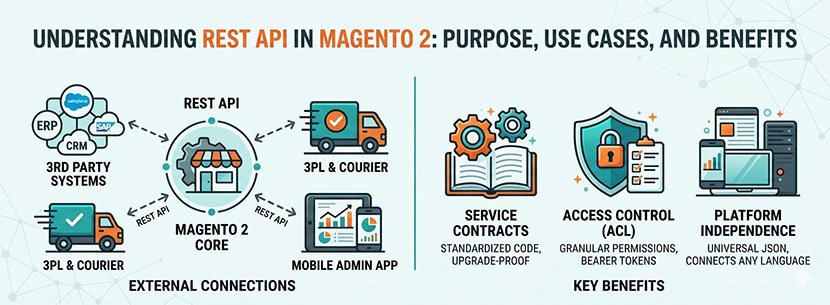
The true purpose of REST API in Magento 2 is to act as a standardized, secure global gateway. It allows external applications—or environments living entirely outside the core Magento codebase—to read from and write to your database reliably.
2. Real-World Applications: When Do You Actually Need REST API?
You should focus on developing and exposing REST API endpoints (using POST, PUT, and DELETE methods) when your store needs to interface with external ecosystems. Here are the most common scenarios:
• Seamless ERP / CRM / POS Integration
This is the most frequent use case for enterprise-level Magento merchants. When a business manages its global inventory, pricing, and customer relationships on an external platform like SAP, Odoo, Salesforce, or a local POS system:
- Every time a product is added or a price changes on the ERP, that external system triggers a
POST /V1/productsrequest to update Magento automatically. - Conversely, when a new order is placed on the storefront, Magento sends data via API to the third-party system for invoice generation and accounting.
• Third-Party Logistics (3PL) & Shipping Couriers
Modern shipping companies rely heavily on real-time webhooks. When a delivery courier marks a shipment as "Successfully Delivered" on their handheld application, their automated backend fires a REST API request to your Magento site. This instantly generates the invoice and shifts the order status to Complete without any manual admin intervention.
• Dedicated Administrative Mobile Apps
If you build a native mobile app (using Flutter, React Native, or Swift) designed for store managers to track revenue, approve pending articles, or quickly alter product inventory on the go, you must use REST APIs. Because mobile apps cannot share traditional browser cookies or web sessions, APIs are the mandatory bridge.
3. Core Benefits of Using REST API in Magento 2
Magento 2’s API framework is highly regarded in the e-commerce industry due to several engineering advantages:
- Strict Standardization via Service Contracts: Magento 2 forces you to declare APIs using PHP Interfaces. This design pattern guarantees code cleanlines, strict data typing, and ensures your custom endpoints remain completely "upgrade-proof" when upgrading core Magento versions.
- Granular Access Control (ACL): Security is managed effortlessly through the
webapi.xmlconfiguration file. Access can be restricted to three clear tiers: Anonymous (public guests), Self (logged-in customers accessing their own data), and specific backend permissions (e.g.,Magento_Backend::content) requiring an Admin Bearer Token. - Platform Independence: REST APIs serialize data into JSON—the universal language of modern computing. Whether your partner's system is built on Python, Java, NodeJS, or standard PHP cURL, they can easily interact with your Magento store without compatibility bottlenecks.
4. The Developer's Rule of Thumb
REST API is an incredibly sharp tool, but an experienced Magento engineer knows exactly when to wield it:
Choose the Web Admin Route (Controllers + UI Components): If the CRUD functionality is intended strictly for internal administrators working directly inside the standard desktop browser interface.
Choose the REST API Route (or GraphQL for Headless/PWA frontends): When your system needs to open its doors to external servers, automated background synchronization, or mobile clients.
By respecting these architectural boundaries, you keep your codebase lean, optimize server resources, and ensure your site is built to scale.
